
The hip is one of the body’s largest joints. It is a ball-and-socket joint. The socket is formed by the acetabulum, which is part of the pelvis bone. The ball is the femoral head, which is the upper end of the femur (thighbone). The bone surfaces of the ball and socket are covered with articular cartilage, a smooth tissue that cushions the ends of the bones and enables them to move easily.
A thin tissue called the synovial membrane surrounds the hip joint. In a healthy hip, this membrane makes a small amount of fluid that lubricates the cartilage and eliminates almost all friction during hip movement. Bands of tissue called ligaments (the hip capsule) connect the ball to the socket and provide stability to the joint.
The most common cause of chronic hip pain and disability is arthritis.
Osteoarthritis, rheumatoid arthritis, and traumatic arthritis are the most common forms of this disease.
The hip is one of the body’s largest joints. It is a ball-and-socket joint. The socket is formed by the acetabulum, which is part of the pelvis bone. The ball is the femoral head, which is the upper end of the femur (thighbone). The bone surfaces of the ball and socket are covered with articular cartilage, a smooth tissue that cushions the ends of the bones and enables them to move easily.
A thin tissue called the synovial membrane surrounds the hip joint. In a healthy hip, this membrane makes a small amount of fluid that lubricates the cartilage and eliminates almost all friction during hip movement. Bands of tissue called ligaments (the hip capsule) connect the ball to the socket and provide stability to the joint.
The most common cause of chronic hip pain and disability is arthritis.
Osteoarthritis, rheumatoid arthritis, and traumatic arthritis are the most common forms of this disease.
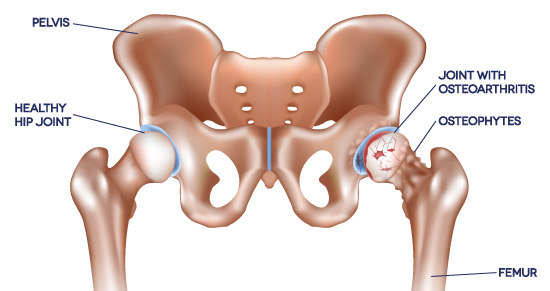
Osteoarthritis
This is an age-related wear and tear type of arthritis. It usually occurs in people 50 years of age and older and often in individuals with a family history of arthritis. The cartilage between the bones of the hip wears away. The bones then rub against each other, causing hip pain and stiffness.
Osteoarthritis may also be caused or accelerated by subtle irregularities in how the hip developed in childhood.
Rheumatoid arthritis
This is an autoimmune disease in which the synovial membrane becomes inflamed and thickened. This chronic inflammation can damage the cartilage, leading to pain and stiffness.
Rheumatoid arthritis is the most common type of a group of disorders termed inflammatory arthritis.
Rheumatoid arthritis
This is an autoimmune disease in which the synovial membrane becomes inflamed and thickened. This chronic inflammation can damage the cartilage, leading to pain and stiffness.
Rheumatoid arthritis is the most common type of a group of disorders termed inflammatory arthritis.
Other types of arthritis
Posttraumatic arthritis. This can follow a serious hip injury or fracture. The cartilage may become damaged and lead to hip pain and stiffness over time.
Osteonecrosis. An injury to the hip, such as a dislocation or fracture, may limit the blood supply to the femoral head. This is called osteonecrosis (also sometimes referred to as avascular necrosis). The lack of blood may cause the surface of the bone to collapse, and arthritis will result. Some diseases can also cause osteonecrosis.
Childhood hip disease such Dysplasia, Perthes disease and Slipped femoral epiphysis can lead to osteoarthritis in adult life.
Even though the problems are successfully treated during childhood, they may still cause arthritis later in life. This happens because the hip may not grow normally, and the joint surfaces are affected.
Hip joint replacement therapy
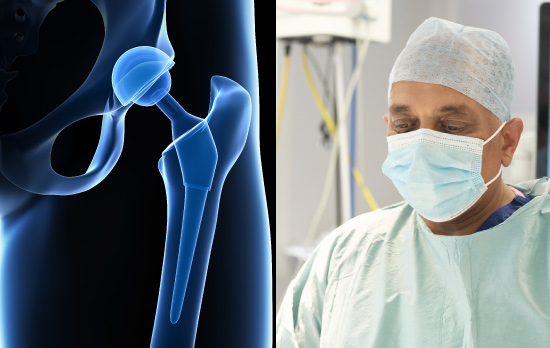
The aim of hip joint replacement surgery is to relieve your pain correct any deformity, such as leg length inequality restore any loss of function to your hip improve your quality-of-life Hip replacement surgery involves replacing the head of the femur (ball) and the acetabulum (socket) with man-made components called a prosthesis.
Your surgeon will choose the one considered most suitable for you, although the final decision may need to be made during your operation. Bearings: The points where the moving parts of a hip replacement connect are referred to as bearings. Surgeons will choose a bearing combination that best suits your needs. Possible bearing materials are metals, ceramics, and plastics. With advancements in technology and manufacturing these bearing materials have become reliable. What goes into a hip joint replacement?
A hip prosthesis is made up of several parts:
- The acetabular component replaces the acetabulum and can be either a metal alloy outer shell with a fitted plastic (a.) or ceramic liner (b.), or it can be a single plastic component.
- The femoral component replaces the femoral head. This is known as a ‘modular prosthesis’ and consists of the femoral stem, made of metal alloy, and the femoral head that attaches to the stem, made of either ceramic or metal alloy.
- Cementless femoral stem with ceramic head/polyethylene liner
- Cementless femoral stem with metal head/plastic liner
- Over time, the components of the hip replacement can wear or become loose, and patients may have pain and find walking difficult. This will require another operation to remove the old hip replacement (or parts of it) and put a new one in. This is a more complex operation, and it may be longer before you are mobile and allowed to put full weight on your operated leg.