
The surgeons at Castleview Clinic are familiar with the best-established, as well as the most promising new techniques in articular cartilage repair and regrowth.
The surfaces of the bones that articulate in the knee joint are covered with cartilage. This articular cartilage may also be referred to as hyaline or chondral cartilage, and is sometimes compared to the rubber on the tyres of a wheel. It is different from the horse-shoe meniscal cartilage which sits between the articular surfaces.
The surgeons at Castleview Clinic are familiar with the best-established, as well as the most promising new techniques in articular cartilage repair and regrowth.
The surfaces of the bones that articulate in the knee joint are covered with cartilage. This articular cartilage may also be referred to as hyaline or chondral cartilage, and is sometimes compared to the rubber on the tyres of a wheel. It is different from the horse-shoe meniscal cartilage which sits between the articular surfaces.
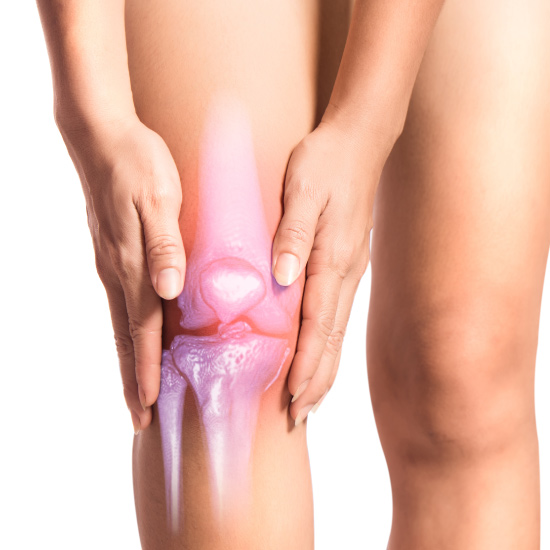
In some circumstances, a limited area of surface cartilage may be damaged, resulting in a pot-hole surrounded by otherwise normal cartilage. This is often the result of an identifiable injury, and is best diagnosed with an MRI scan. In these cases of discrete injury, attempts to re-grow cartilage to fill the pot-hole are associated with a greater chance of success.
The surgeons at Castleview Clinic recognize that successful cartilage re-growth depends on the overall condition of the knee. We believe the key first step in successful cartilage repair is a detailed assessment of the overall alignment and stability of the knee, as well as the integrity of the meniscal cartilage. We may advise that knee realignment (osteotomy), ligament reconstruction, or meniscal transplantation is required before or alongside your cartilage repair procedure.
Numerous techniques exist to treat chondral defects. We can recommend a particular technique based on size and location of the defect, and the extent of any associated bone loss. Some of the newer techniques are available in only a small number of hospitals in the UK. The surgeons at Castleview Clinic recognize the importance of performing the most effective surgery first, so where we cannot perform the most appropriate surgery locally, we will refer to national centres with whom we have close links.
In some circumstances, a limited area of surface cartilage may be damaged, resulting in a pot-hole surrounded by otherwise normal cartilage. This is often the result of an identifiable injury, and is best diagnosed with an MRI scan. In these cases of discrete injury, attempts to re-grow cartilage to fill the pot-hole are associated with a greater chance of success.
The surgeons at Castleview Clinic recognize that successful cartilage re-growth depends on the overall condition of the knee. We believe the key first step in successful cartilage repair is a detailed assessment of the overall alignment and stability of the knee, as well as the integrity of the meniscal cartilage. We may advise that knee realignment (osteotomy), ligament reconstruction, or meniscal transplantation is required before or alongside your cartilage repair procedure.
Numerous techniques exist to treat chondral defects. We can recommend a particular technique based on size and location of the defect, and the extent of any associated bone loss. Some of the newer techniques are available in only a small number of hospitals in the UK. The surgeons at Castleview Clinic recognize the importance of performing the most effective surgery first, so where we cannot perform the most appropriate surgery locally, we will refer to national centres with whom we have close links.
In some patients with one or two focal chondral defects, the potential for cartilage regrowth is limited, and it may be more appropriate to fill the defect with a metal button. The surgeons at Castleview Clinic use the Episealer implant. A virtual 3D model of the damaged femoral knee joint is recreated from an MRI scan. Based on this model, individualized instruments are designed to remove the damaged tissue as well as to restore the area with a perfectly fitting implant.
The focal cartilage defects discussed above are very different to arthritis. In arthritis the chondral cartilage degrades and becomes thinner across a widespread area, or in multiple areas, over time. This gives the impression of the bones becoming closer together, or even touching on a standing xray of the knee.
In these situations, the surgeons at Castleview Clinic are likely to advise that attempts at repair or regeneration of the chondral cartilage are not usually associated with high rates of success. If surgery is considered in these cases, osteotomy, or joint replacement may be more appropriate.
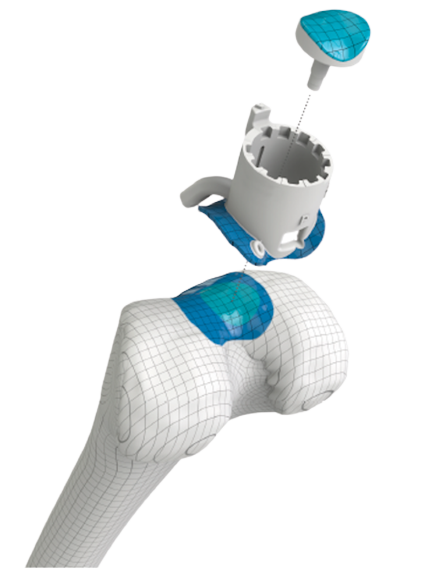
Episealer Implant
In some patients with one or two focal chondral defects, the potential for cartilage regrowth is limited, and it may be more appropriate to fill the defect with a metal button. The surgeons at Castleview Clinic use the Episealer implant. A virtual 3D model of the damaged femoral knee joint is recreated from an MRI scan. Based on this model, individualized instruments are designed to remove the damaged tissue as well as to restore the area with a perfectly fitting implant.
The focal cartilage defects discussed above are very different to arthritis. In arthritis the chondral cartilage degrades and becomes thinner across a widespread area, or in multiple areas, over time. This gives the impression of the bones becoming closer together, or even touching on a standing xray of the knee.
In these situations, the surgeons at Castleview Clinic are likely to advise that attempts at repair or regeneration of the chondral cartilage are not usually associated with high rates of success. If surgery is considered in these cases, osteotomy, or joint replacement may be more appropriate.