
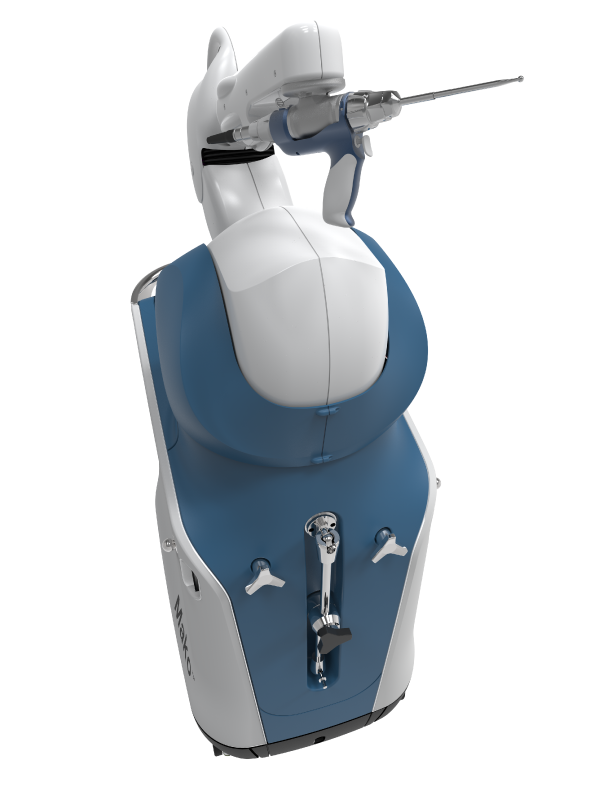
At the Princess Margaret Hospital, our team has access to one of the most advanced technologies in orthopaedic surgery: a joint-replacement robot called MAKO.
Traditionally knee replacements have been done using metal alignment ‘jigs’ that are either clipped to the patient’s leg or a rod-is passed up the inside of the long bone to line up the implants. Some of this alignment technique relies on the surgeon’s eyes. MAKO uses a highly advanced navigation system to assist your surgeon in implant placement and ligament balancing to an accuracy of 0.1 millimetres.
At the Princess Margaret Hospital, our team has access to one of the most advanced technologies in orthopaedic surgery: a joint-replacement robot called MAKO.
Traditionally knee replacements have been done using metal alignment ‘jigs’ that are either clipped to the patient’s leg or a rod-is passed up the inside of the long bone to line up the implants. Some of this alignment technique relies on the surgeon’s eyes. MAKO uses a highly advanced navigation system to assist your surgeon in implant placement and ligament balancing to an accuracy of 0.1 millimetres.
A CT scan is performed of your knee prior to the procedure. This creates a 3-dimensional map of your knee – the images from this are fed into MAKO’s computer.
At the time of surgery, the robot and your surgeon work together using a computerised virtual model of your knee with the proposed knee replacement to create optimal ligament balancing.
Ligament balancing is crucial for long-term function of the knee. Once the implant placement and balance have been confirmed by the surgeon, the fine bone-cuts are made by a saw on the end of MAKO’s highly sophisticated cutting arm. The cutting arm will not ever move outside the boundaries of the programmed cut thereby protecting the body’s surrounding nerves, arteries, ligaments and other soft tissue structures from inadvertent damage.
Not every knee replacement operation can be performed using the robot. In some cases, such as when an old knee replacement needs to be taken out (a revision procedure) the robot cannot be used as the technology has not quite advanced that far yet. Your surgeon will discuss whether the robot can be used and if not, how else the surgery can be done at your consultation.
MAKO is made by a US company called Stryker. The total knee replacement implanted using this system is called Triathlon.
The partial knee replacement implanted by this system is called Restoris. Both of these implants have excellent long-term survival data on the National Joint Registries.

MAKO is made by a US company called Stryker. The total knee replacement implanted using this system is called Triathlon.
The partial knee replacement implanted by this system is called Restoris. Both of these implants have excellent long-term survival data on the National Joint Registries.