
The meniscus (plural = menisci) is the cartilage ‘cushion’ inside the knee. There are two of them in each knee: one on the inside of the knee – the medial meniscus and one on the outside of the knee – the lateral meniscus. They are each shaped like a crescent moon and are vital structures that transmit load between the two main bones of the knee, the femur and the tibia. Some knee surgeons believe they are most important structure within the knee.
The meniscus (plural = menisci) is the cartilage ‘cushion’ inside the knee. There are two of them in each knee: one on the inside of the knee – the medial meniscus and one on the outside of the knee – the lateral meniscus. They are each shaped like a crescent moon and are vital structures that transmit load between the two main bones of the knee, the femur and the tibia. Some knee surgeons believe they are most important structure within the knee.

Meniscal tears
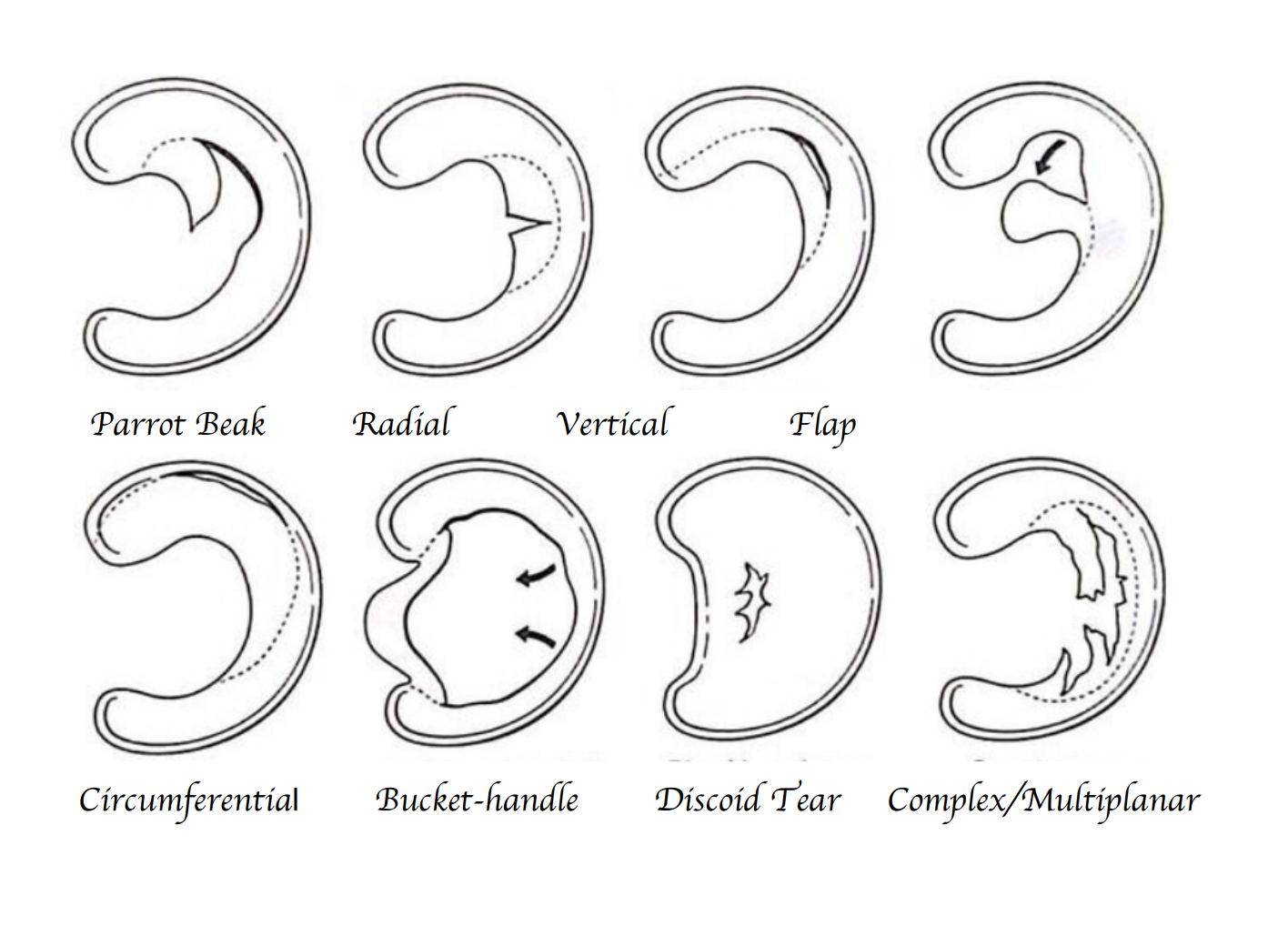
Meniscal tears are not uncommon. They occur as you go through life due to the huge loads that are transmitted through your knee especially during sport. There are different types of tears of the meniscus.
They are usually classified into the pattern of the tear, the position of the tear and the age of the patient. Big meniscal tears (including ‘bucket-handle tears’) can be very serious and stop the knee from straightening. We call this a locked knee and often it needs urgent surgery.
With smaller tears, the knee can function completely normally but sometimes they irritate the knee doing certain movements such as squatting and manifest as pain and swelling. Meniscal tears do not show on an xray or with ultrasound scanning. They are diagnosed with an MRI scan.
Meniscal tears
Meniscal tears are not uncommon. They occur as you go through life due to the huge loads that are transmitted through your knee especially during sport. There are different types of tears of the meniscus.
They are usually classified into the pattern of the tear, the position of the tear and the age of the patient. Big meniscal tears (including ‘bucket-handle tears’) can be very serious and stop the knee from straightening. We call this a locked knee and often it needs urgent surgery.
With smaller tears, the knee can function completely normally but sometimes they irritate the knee doing certain movements such as squatting and manifest as pain and swelling. Meniscal tears do not show on an xray or with ultrasound scanning. They are diagnosed with an MRI scan.
Meniscal Repair
As the meniscus is such a precious structure we do always try to preserve it when it is torn. It can sometimes be repaired via arthroscopic (key-hole) surgery. This is very much dependent however on the type of tear, site of tear, the age of the patient and how long it has been since it was torn.
The meniscus has a very limited blood supply particularly towards the inner side which means it often does not heal well. The ability for the meniscus to heal dwindles with the age and therefore sometimes removing the loose piece to settle symptoms is a better option than trying to repair it.
Your surgeon will make the final decision regarding healing at the time of surgery when the tear has been properly visualized. Repair involves putting tiny stitches into the meniscus to encourage it to heal.
After meniscal repair you will often be required to wear a knee brace for up to 6 weeks to prevent the knee from bending too much which can open up the stitches.
Meniscal Repair
As the meniscus is such a precious structure we do always try to preserve it when it is torn. It can sometimes be repaired via arthroscopic (key-hole) surgery. This is very much dependent however on the type of tear, site of tear, the age of the patient and how long it has been since it was torn.
The meniscus has a very limited blood supply particularly towards the inner side which means it often does not heal well. The ability for the meniscus to heal dwindles with the age and therefore sometimes removing the loose piece to settle symptoms is a better option than trying to repair it.
Your surgeon will make the final decision regarding healing at the time of surgery when the tear has been properly visualized. Repair involves putting tiny stitches into the meniscus to encourage it to heal.
After meniscal repair you will often be required to wear a knee brace for up to 6 weeks to prevent the knee from bending too much which can open up the stitches.

Meniscal Trimming
(Partial Meniscectomy)
If the meniscal tear is not repairable then the loose edges are trimmed with very fine instruments until the edges are smooth again. Rarely is the whole meniscus removed. We will always try to preserve as much of it as possible.
There has been a lot of bad press surrounding meniscal surgery in the last few years regarding the effectiveness of it. Some randomised clinical trials have shown that patients symptoms are still the same with non-operative management as they are with surgical management at two years after the start of the treatment. Your surgeon will talk to you about the suitability of your meniscal tear for a non-operative or operative approach.
As a general rule our surgeons follow the British Association of Surgery to the Knee (BASK) algorithm guidelines on the treatment of meniscal tears, available here:
Meniscal Trimming
(Partial Meniscectomy)
If the meniscal tear is not repairable then the loose edges are trimmed with very fine instruments until the edges are smooth again. Rarely is the whole meniscus removed. We will always try to preserve as much of it as possible.
There has been a lot of bad press surrounding meniscal surgery in the last few years regarding the effectiveness of it. Some randomised clinical trials have shown that patients symptoms are still the same with non-operative management as they are with surgical management at two years after the start of the treatment. Your surgeon will talk to you about the suitability of your meniscal tear for a non-operative or operative approach.
As a general rule our surgeons follow the British Association of Surgery to the Knee (BASK) algorithm guidelines on the treatment of meniscal tears, available here: